
Note: this article is being built upon in my follow up on the Anthropic S-1 where I critique some of the conclusions in this article, all of whom I leave unchanged for reference.
This meme was one of the highlights for me this year, but how accurate is it really?
There's a lot of information regarding the financials in "the other end" as it were, ie the financing of the data centers and the entities that are borrowing the money and their ability to pay (or not), Ed Zitron does a fantastic job here. But I haven't seen any "bottom up" estimates.
Note, this article was written in Oct - Nov of 2026, things move fast with this so keep that in mind. If you read this in 2027 or later this article is probably just a historical account and completely irrelevant for you.
So, without further ado, let's get to it. But let's start at the very, very bottom, the DIY setups and home builds.
In order to build GraphSeam (check it out, it's in Beta) and avoid the stress of a constantly decreasing balance on OpenRouter I decided to buy two local machines for in total 311k THB, this is roughly 10k USD.
Let’s take a look at how many tokens they’ve handled:
Input: 2.65G / Output: 175M / Whisper: 27k hours of audio has been transcribed.
I’ve spent about 20 USD on electricity for AI so far.
Now let’s look what it looks like on OpenRouter, the DeepSeek Flash pricing (a model which according to my experience is just as good or better than the Qwen models I’ve been using locally, which it should be, it’s a multi 100B large model compared to ca 30B, and it's currently the cheapest there, some kind of promo probably): In / Out Price: $0.049 / $0.375 per 1M
So, the work would’ve set me back (2650 * 0.049) + (175 * 0.375) = 195 USD
And Whisper Turbo which is the model I’ve been using to transcribe podcasts is priced at $0.000003/second, via OpenAI but bizarrely the Chinese alternatives were not cheaper.
27000 * 3600 * 0.000003 = 291 USD
These machines have been on and off for roughly 1.5 months now but I will equate total run time to 1 month if I would’ve been able to run them day and night.
So, that gives 195 + 291 - 20 = 466 USD of value per month.
Total payback time if all the hardware stays solid all the way: 10000 / 466 = 21.5 months, a bit less than two years. Let’s pin the 195 + 291 = 486 number, this is effectively the total for Chinese inference, via a slightly overkill model for the purpose, with 195 USD for the non transcription work.
Let’s compare with eg Anthropic, I’ve tried Haiku and strangely enough it was not performing as well as the Qwen 35B A3B and 3.8 27B models I’ve been using, but I’m sure Sonnet 5.5 would’ve done the trick, the pricing is: 2 in / 10 out per 1M. For some reason Sonnet 4.6 is more expensive (non-MoE perhaps?), why even have it in the inventory, maybe some banks are scared of upgrading and getting different output?
Anyway let’s plug the Sonnet pricing in: (2650 * 2) + (175 * 10) = 7050
OK so our first realization: either the OpenAI / Anthropic pay per token setup is fantastically, insanely profitable, or the subscription business is losing a nauseating and horrible amount of money.
What we do know is that the US frontier labs are 7050 / 195 = 36 times more expensive than the Chinese, however, Sonnet 5.5 would probably have performed a bit better than DeepSeek Flash, but not by much, we’re not solving Navier Stokes here, we’re trying to find company mentions in transcribed podcast audio.
Let’s dig into the actual hardware that is being used by the two US labs though and how it relates to the various subscription plans and usage profiles.
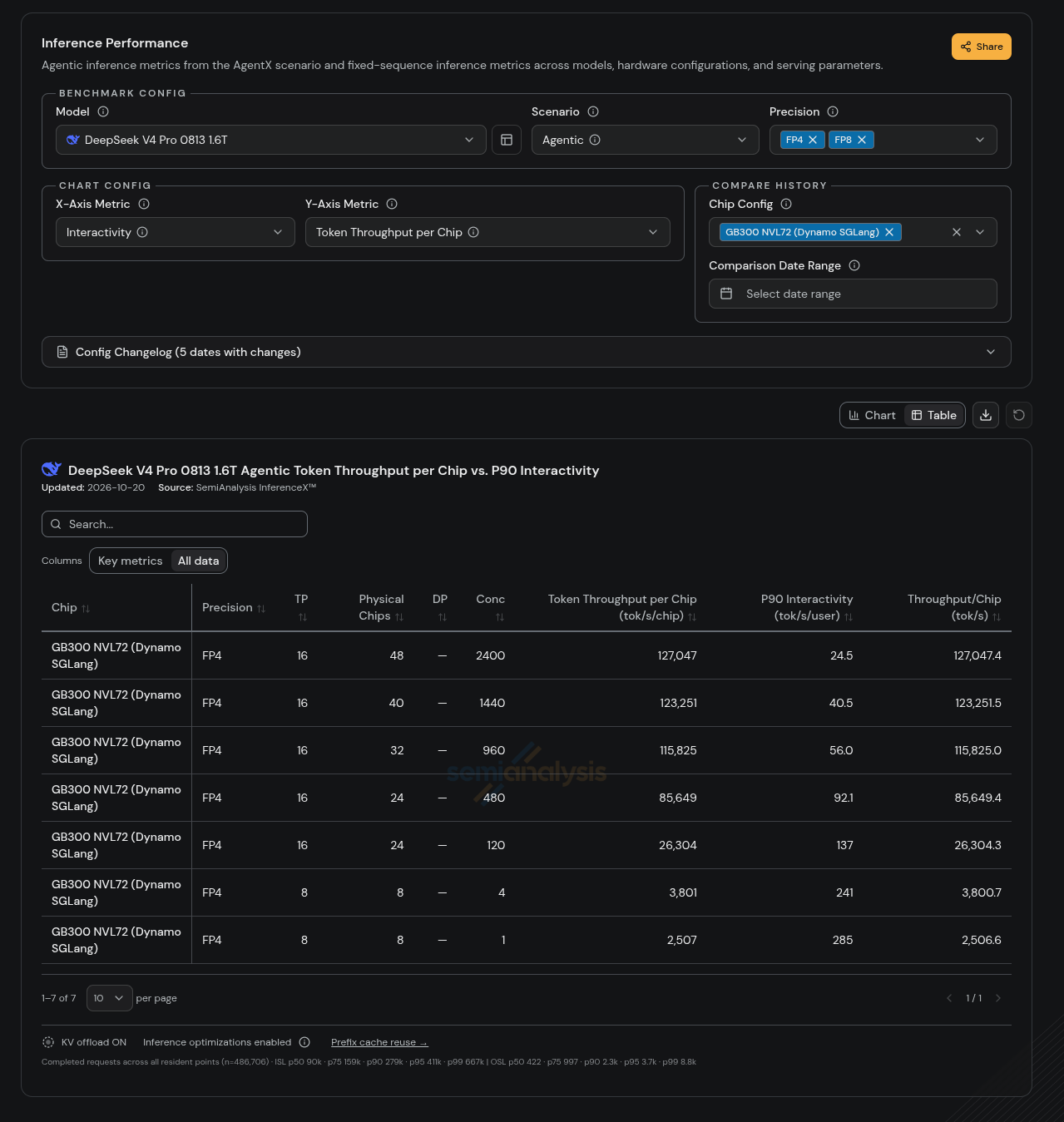
If we look at the below InferenceX table we see that 24 GB300s support 480 concurrent agents (standard / average usage pattern, constant load is roughly is only 48 but that is not normal usage, and the model is DeepSeek Pro but that probably results in understated numbers as opposed to if Opus had been used), I’m using about 5 agents at the same time and I use up roughly 80% of my weekly allowance on my $100 plan, so let’s make that 6 then to be nice, for the 100% utilization scenario. 480 / 6 = 80 and 80 times 100 is 8000. 8000 / 24 = 333 bucks per GB300 unit per month. A rack fits 72 of them so 333 * 72 = 23976 per rack per month in revenue.
 Source for the rack power consumption, it's 2.12kW * 72 = 153kW
FRED Electricity cost gives $0.2 / kWh.
The rack pulls 153kW which at 0.2 per kWh becomes 153 * 0.2 * 24 * 30 = 22032
OK so the electricity bill is almost the income per rack, I will stop there, I think we can conclude that someone like me is not a profitable customer, the meme checks out.
But everyone isn't using 100% or even 80% of their allowance, here are a few more positive scenarios given average customer utilization:
50%: 47952
25%: 95904
10%: 239760
It’s remarkably hard to get a proper price / rack for these things, here is one estimate anyway.
So, let's go with 5M per rack, and it will depreciate over 3 years. Here is Hopper vs Blackwell, these things will not lose value because they break, they will lose value because Jensen & Co are so damn good at cranking out new and better gear every year. That chart is almost a joke, poor sods who bought Hopper. Vera Rubin will be yet another leap with 10x lower cost per million tokens which will in turn obsolete Blackwell.
Let's reach for the tired railway analogy one more time: this is as if the train makers would've released diesel powered trains a few years after steam powered trains, then standard electricity powered ones shortly after that and finally after a few years bullet trains going 400 km/h. The steam powered trains would go from the only game in town in year 1 to museum pieces 10 years later.
5,000,000 / (3 * 12) = 139k / month in depreciation costs
What's left now is the datacenter costs, ie building them, buying all the UPSes, the wiring etc. That stuff does not at all depreciate at the same speed as the Nvidia stuff because it doesn't get obsoleted, so let's call it 10k / rack / month, that's a number Gemini came up with that I can believe in, we're then looking at a total cost per rack of:
139k + 10k + 22k = 171k
Breakeven then lies around 15% utilization (backing out the pay per token and the $200 / month subscribers for simplicity's sake, the pay per token people are ofc positive but the 200 / month subscribers are probably negative so they might cancel to some extent).
I find the 15% number hard to believe, I could buy a 30-50% rate which gives us something between 50-80k / rack / month.
The difference between 80k and 171k is stark, and that is if you've been paying for this stuff with your cash flows, everyone who borrowed for this is in an even more hilariously tragic situation.
So with that in mind, the rest follows, the plea to “pace the frontier” is actually a plea to “let us pause the training so we all can IPO with some kind of margins”. Somewhere, someone is keeping the show going via their token spend, barely. TODO now is to get some kind of regulations going so that it becomes impossible to use the Chinese models for US based companies, that should increase revenues, that takes care of the top line and the training pause takes care of the bottom line, IPO secured.
The name of the game must be to survive with enough cash to buy Vera Rubin or better yet, what comes after Vera, but what will they have to pay for those machines? The only way the AI labs come out of this on top is if there's a supply glut but then Nvidia and the memory makers will crash instead, it's an impossible situation: per definition, everyone can't be winners at the same time here.
But let's explore a post Vera Rubin future, and for simplicity's sake we will imagine two American AI labs that are 100% vertically integrated, one of them started in the Blackwell days (lab X) and their racks are all the GB300 we looked at above, the new upstart lab has only got Vera racks (lab Y).
This article claims the cost per Vera rack will be $7.8M, let's plug that in and assume that x10 improvement:
7800000 / (3 * 12) = 217k
217 + 1 0 + 22 = 249k per month.
So, let's depreciate over 9 years instead:
Blackwell then loses 139 / 3 = 46k / month which then results in 46 + 10 + 22 = 78k / month in total cost.
Vera loses 217 / 3 = 72k / month which gives 72 + 10 + 22 = 104k / month.
This looks pretty favorable until you remember that the 10x improvement takes the Rubin setup down to 10.4k / month on a token basis.
Lab Y would be able to completely undercut lab X, they could offer their coding agent for easily half the price and I would switch in a heartbeat, there is literally zero switching costs (I should know, I've switched 3 times already and was up and running within 5 minutes of switching).
So, trying to depreciate over 9 years is not realistic, the obsolescence math prevents that.
It's brutal, the insane effectiveness and innovation of Nvidia, coupled with the unreasonably high HBM prices guarantees that the picks and shovels companies will kill the hand that feeds them.
Bonus: Nvidia claims 45x lower token cost on agentic workloads (the above CoreWeave link tested with a single prompt which is a different workload so Nvidia's numbers should not be immediately dismissed as marketing hyperbole).
Get new posts by email
No spam, unsubscribe any time. Or follow via RSS