
I don't think it has escaped anyone remotely interested in how AI works under the hood that the machines it runs on require ungodly amounts of memory.
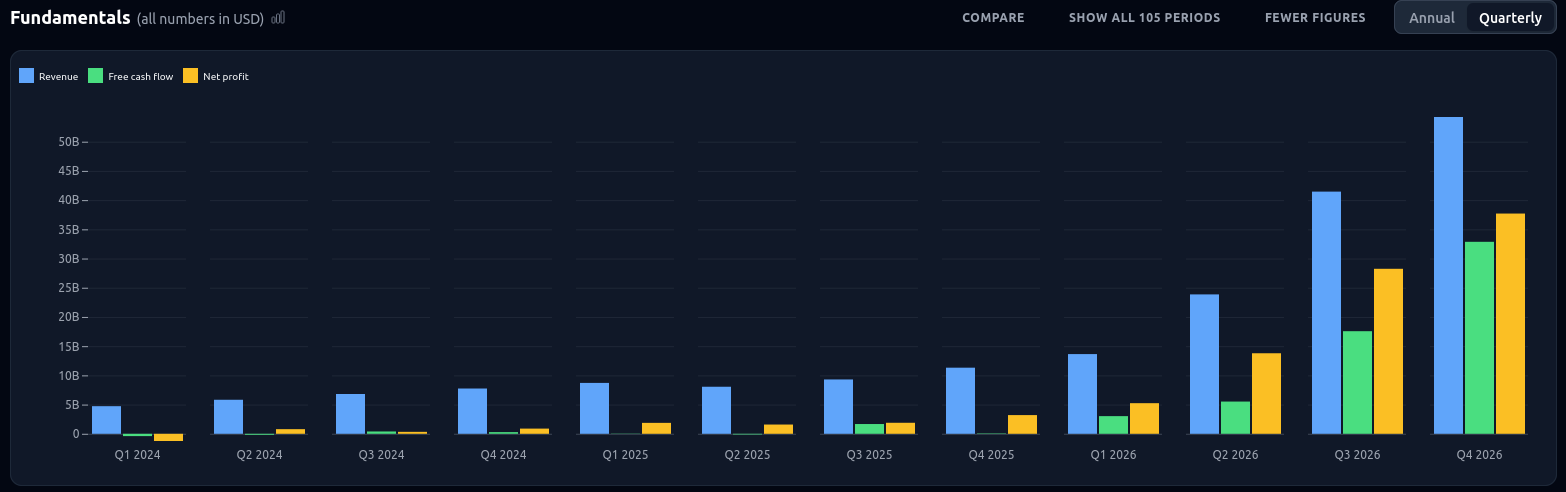
I think it was this spring / early summer that I first really understood what the hell was going on within the space due to the incessant online chatter about the memory makers and how their stocks were going ballistic. I finally caved and checked Micron's fundamentals and I saw this:
Screenshot from here
That makes it fairly clear doesn't it? A company that was barely having a positive cash flow just a few quarters earlier was now accumulating 17 billion per quarter (this was before the latest quarter, and note that their fiscal year ends in Aug), apart from Nvidia's numbers I've never seen anything like it.
The basic theme here is that this company didn't 100x their production, prices just increased until the gamers got priced out of the market and hyperscalers started balking.
Assembly of the High Bandwidth Memory (HBM) units (aka "packaging" in industry lingo) can be done in facilities separate from the ones doing the etching of the wafers. Micron has already expanded this capacity in 2026 because it it was a bottleneck, which is reflected in the above numbers (ie HBM capacity doubled without any new fabs being built), plus it's cheaper than expanding wafer capacity, and quicker.
Fabs are currently under construction in Idaho and New York, the one in NY is partly paid for by the US govt via the CHIPS act. Odd Lots has an interesting interview with Kathy Hochul where they talk about the NY fab among other things. In the Q4 FY26 disclosure Micron claims that 32b is being fronted by customers, or promised as take or pay (so far). A big customer is ofc Nvidia and any take or pay contracts there will add to Nvidia's already big pile of commitments. The take or pay puts a floor and ceiling on the pricing, also from the FY26:
We expect gross margins from our strategic customer agreements with price bands, even at floor pricing levels, to yield gross margins meaningfully above our historical cycle averages
So there you have it, funding secured, no circular deals, no payment in equity, if you want HBM you pay with cold hard cash.
And keep in mind now that this is just one of three players, SK Hynix and Samsung are the other two and they have also struck similar capacity deals, Nvidia et al will be forced to pay for output even in a scenario where demand falters. The big 3 will probably not enforce the take or pay agreements fully but I think it's safe to assume that they will take the prepayments of which only Micron's share is 32b. I didn't manage to get a handle on the total over all 3 as the Korean companies aren't as transparent as Micron.
In any case, all 3 are planning capacity expansions and all 3 have secured funding to soften the typical chip bust that is so reminiscent of the commodity cycle, with the miners, oil drillers etc.
The funny part here is that SK Hynix employees had a profit sharing deal of 10% which turned out to be about $100k per person for about 35k people this year. Samsung's chip employees got so envious that they threatened a massive strike and so also got a similar deal. So, now you know where the money you're paying for your Google ad campaign ends up, in the bank accounts of South Korean condo developers, bet you didn't see that one coming did you!?
I find this hardware mania, that ends up as massive windfalls for the memory makers, to be a highly disturbing feature of the AI boom. Insane amounts of money are being paid for memory, that was being sold for a fraction of the price just a year prior, without any value add.
Get new posts by email
No spam, unsubscribe any time. Or follow via RSS